The last part of our trip took us to the southernmost tip of Taiwan. We left Kaohsiung after lunch and it took almost two hours to get to Kenting, so we didn't have time to do much that day except check-in and eat dinner.
Luckily, the streets of Kenting are filled with restaurants and food stands. After walking up and down the main street a few times (too many Western and Thai restaurants!) we found an authentic Taiwanese place, where we had sticky rice in bamboo, pork over rice, a very interesting vegetable that I hadn't eaten before (local specialty) which tasted a bit like the outsides of sweet peas, and some other goodies.
After dinner, we wandered the streets looking for snacks and desserts. We ended up eating green tea frozen yogurt, fried milk, grilled squid, "sausage wrapped in sausage", and more.
Bright and early the next day, we were off to Kenting National Park (墾丁國家公園). There are lots of beautiful trees, ferns, and other plants inside.
The land that is now Kenting was once underwater, and many of the rock formations in the area are actually comprised of ancient coral reefs. As a result, there are some impressive ravines and such.
Last year at the Taiwanese-American Cultural Festival, I learned that nearly 60% of the world's supply of orchids originate from Taiwan. Inside the park, we found a greenhouse full of orchids and other tropical flowers, which my mom enjoyed very much.
We wound up our visit at the new(-ish) National Museum of Marine Biology & Aquarium. We've been to really nice aquariums in Dubai (UAE), Valencia (Spain), and near home in Monterey (California), and I was pretty impressed with this one. They have a giant coral reef exhibit that has three separate tubes inside which give visitors great views of all the sea life. They have a whale shark (we watched the feeding, which was fun), two beluga whales, lots of manta rays, and other cool-looking creatures that I couldn't identify. They also have a some Gentoo penguins, which might have impressed me a few years ago, but not after having seen the Magellanic Penguin colony in Argentina and the Little Penguins on Phillips Island.

We left Kenting at around 5:15pm, and were on an express train bound for Taipei by 7:06pm. We arrived exactly ninety-six minutes later (love the high-speed rail), and grabbed a late wonton soup dinner before heading to bed.
Overall, it was an awesome trip, and I look forward to being a tourist in Taiwan again soon. Next time: Hualien, Taroko Gorge, and Sun Moon Lake!
Friday, May 14, 2010
tourists in Taiwan, part 4: Kenting
Thursday, May 13, 2010
tourists in Taiwan, part 3: Kaohsiung
From Tainan we drove about an hour south to Kaohsiung.
Kaohsiung is the second-largest city and the largest port in Taiwan. In 2009, it hosted the World Games, which consists primarily of sports which are not in the Olympics. Almost 6,000 athletes from over 100 countries attended the Kaohsiung games.
A brand-new, entirely solar-powered stadium (with 8,844 solar panels) was built to accommodate the games; it's said to resemble a dragon:
Unfortunately, it was a bit drizzly when we went to go take a look, so I didn't get a good photo of it.
I forget the name of the hill that we drove up, but eventually we did get a pretty good view of the harbor itself.
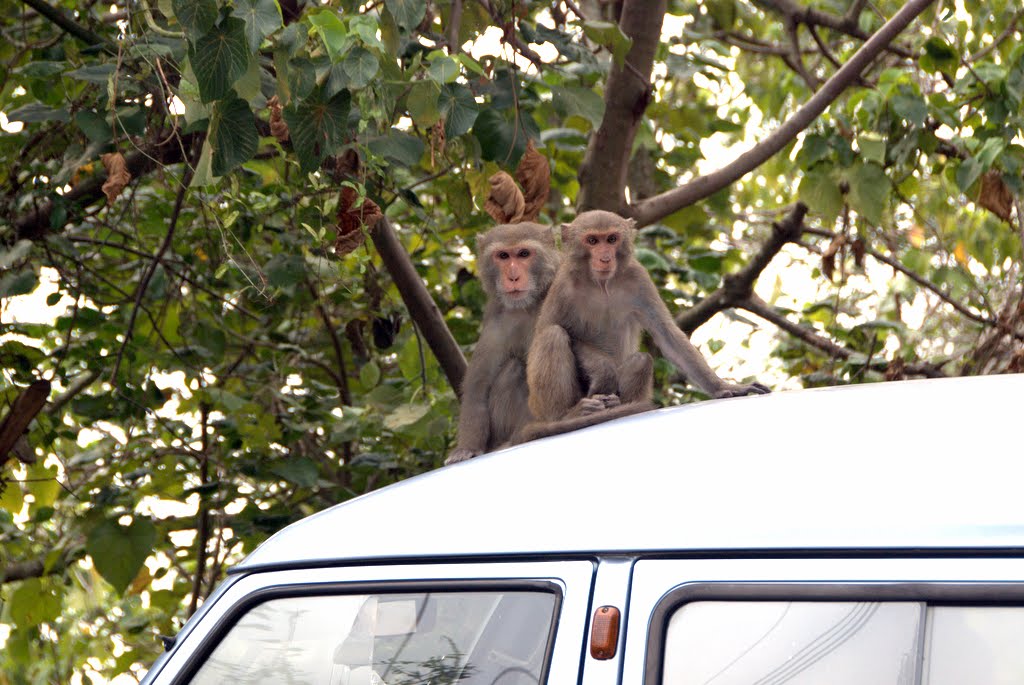
Nearby was another hill called 柴山 ("Chai" Mountain). There is a major university located there, and so there are a TON of motorbikes parked all along the road leading up to the top. Apparently Chai Shan is famous for its monkeys! We saw a quite a few; these guys were hanging out on a parked car.
We also took a ferry to 鼓山 ("Gu" Mountain), an older area of town. There was a temple there and some street vendors selling various types of seafood, but we just spent most of our time watching the gigantic container ships coming in and out of Kaohsiung Harbor.
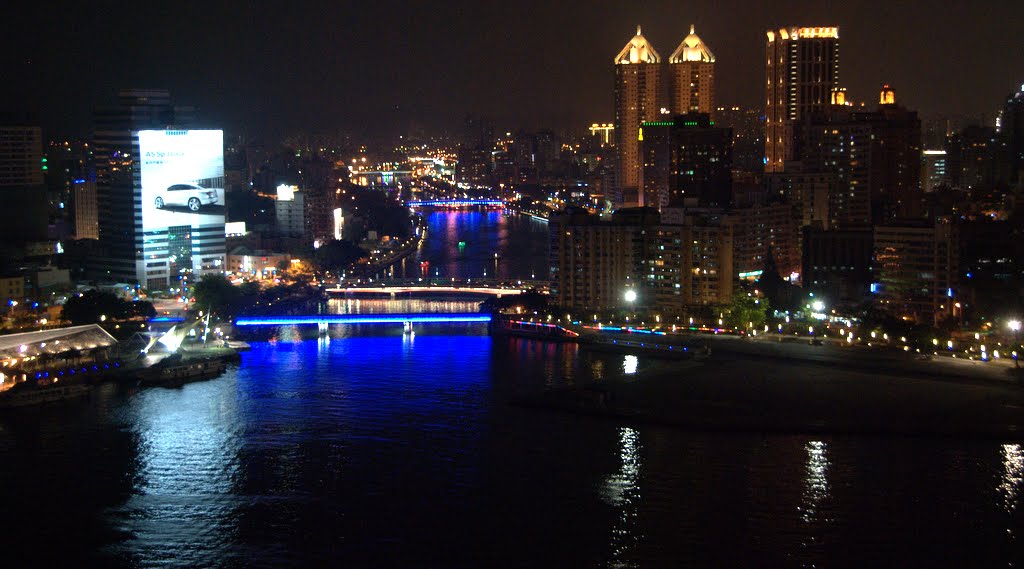
We had a buffet dinner at the Harbor Buffet, up on the 43rd floor of the Grand Hi-Lai hotel, and then went to visit some relatives at their home. These photos were taken from the roof of their building, facing the harbor.

The next day, the same relatives invited us to visit their old house, which is over a hundred years old. I was most interested in the (still functional) WWII-era bomb shelter and water well in the backyard.

Finally, we visited one of the nicest stations in Kaohsiung's newly opened subway system. Strangely enough, there were very few people actually riding the subway, but that made it easier for me to take photos.
We wound up our visit with lunch at a delicious seafood restaurant called 海天下 (literally "Sea Under Sky") which I'm told is one of the best restaurants in Kaohsiung. Their fried squid and basil clam dishes were both amazingly fresh and tasty with very little seasoning. D also liked another dish which was some kind of internal organ of a fish. Unfortunately, no one could translate for us; the closest we came was "something like a gizzard" except of course fish don't have gizzards. Oh well.
Tuesday, May 11, 2010
tourists in Taiwan, part 2: historical Tainan
The sightseeing part of our Tainan tour was less extensive than the eating part, but I thought it was also worthwhile.
Taiwan was occupied by both the Dutch and the Spanish in the 1600's. The Dutch settlement, based out of "Fort Zeelandia" in present-day Tainan, lasted nearly forty years. In 1662, a Chinese naval officer named Koxinga expelled the Dutch from Taiwan and ruled the island from Tainan for another twenty years. As a result, there are a variety of colonial-era ruins still remaining in Tainan.
The first one that we visited was the Dutch-era Fort Zeelandia.

We were told that the actual cannons were original but the bases were replicas.
Next we visited Fort Anping, which was built by Koxinga.
Finally, we visited 赤崁樓 ("Chi Kan Lo"), also built during the Dutch occupation. The name literally means "Tower of the Red-Haired Savages" and refers to the Dutch invaders.
Chi Kan Lo is famous for its nine stone turtles bearing tablets inscribed in both Manchurian and Mandarin. It's thought that the tablets were brought during the Ching dynasty Chinese occupation.
I liked this visit the best of all; there were fewer tourists (the other two sights were swarmed of hordes of tourists, mostly from China), and the grounds, including this coi pond, were very pretty.
Overall, Tainan felt a lot more laid-back than Taipei, and seemed to be imbued with a lot more history and culture. For instance, I took this photo out the window while whizzing past a local cemetary.
One notable exception: drivers in Tainan are insane, fearless, and they completely ignore red lights. I asked my aunt about it and she said (my translation), "a red light is just a recommendation".
tourists in Taiwan, part 1: delicious Tainan
Normally when D and I go to Taiwan, we spend the entire time in Taipei visiting relatives and eating at our favorite restaurants. This time, we decided to take a side trip to the south of Taiwan, since neither of us had been down there since before high school.
Our first stop was in Tainan, where my aunt (mom's sister) lives. She'd asked us beforehand what we wanted to eat, and we told her we wanted "小吃" (literal translation: "small eats") so she drew up a list of Tainan's famous 小吃 spots. Despite being pressed for time (we stayed in Tainan a total of maybe 26 hours) we managed to eat nearly everything on her list. (We also hit a few historical sites while digesting; I'll put those in a different post.)
Just after arriving on the HSR from Taipei, we went to 度小月, Tainan's most famous purveyor of 擔仔麵 (danh mi, a kind of noodle dish). The bowls are quite small and I think normally D could have eaten four or five of them, but we were saving our stomachs.
Next up was Chou's. They're known for their shrimp rolls (below), but we also ordered some more noodles, some pork over rice, and some fish ball soup.

We'd already snacked on some red bean cookies from Kobayashi's, but of course there's always room for more dessert, so we went to 安平 for some dao whei (bean curd tofu soup). This one has green bean and tapioca in it.
After some sightseeing, it was time for more snacking; we bought these rice-based snacks from a street vendor; they are topped with black sesame or peanut powder and steamed until they are gooey. Best eaten while hot!
At that point we only had a few hours until dinner, but my aunt insisted we try these oyster & seafood cakes. I'm not a fan of cooked oysters myself, but D seemed to like them.

Shortly afterwards, it was on to dinner. There is a restaurant about 40 minutes outside of Tainan, that advertises that its beef comes from cows that were killed no more than two hours before serving. My sister (aka the beef expert) had been there previously with my aunt, and she pronounced the meat excellent, so we requested that we eat dinner there.
The restaurant itself is very casual and nondescript, and I'm fairly sure I never would have found it myself. (In Taiwan, "it's next to 7-11" is a totally useless description.) The meat is served shabu shabu style, with a plate of vegetables. There was also unlimited 魯肉飯 (stewed meat over rice) as a side/appetizer, but I only ate a bite of it as I was saving room for the good stuff.

Afterwards, our server dumped a whole plateful of rice into the leftover soup and made rice porridge out of it. It was super flavorful and I ate nearly an entire bowl of it despite being very full already.
The second day, we started out with fish ball soup and 油條 (fried dough). We'd had fish ball soup the previous day but apparently this was a special kind of fish ball soup, with all different kinds of fish balls.
We topped off breakfast with "tsai bah tzang", a vegetarian form of 粽子 (rice dumpling?) which only has peanuts inside. It's served with peanut powder and cilantro, and it is yummy but I still like the meat kind better.
Finally, we were on to our last meal in Tainan, at the "A Ha" restaurant. They are known for their crab, which is a type of crab only found near southern Taiwan, but I actually liked the 油飯 (oily rice) underneath it even better than the crab itself. 
This small fish is also a local specialty, although I hear it is better done in some other restaurants. I didn't try it, but it looked hard to eat.
We were originally planning to go to a famous tsua bing (shaved ice) place nearby before leaving town, but then the restaurant gave us this enormous dessert, on the house. As I recall it had sweet rice dumplings, red bean, prunes, and lots of almond tofu. Yum.
Monday, May 10, 2010
another side of Korea
A few closing thoughts on our visit to Korea...
When we went to Korea last August, it was mostly a stopover on the way to Australia and the rest of our trip. We spent two full days in Seoul, knocking off all the touristy items on our list.
This time, although we spent only one full day in Seoul, it felt like more than enough. Other than the food (which was yummy as usual), we mostly hung out in department stores and malls. Unfortunately, the weather was a bit rainy, which did encourage much additional city exploration.
The good thing was that we'd already planned to spend three full days on Jeju Island. Even on arrival, it was obvious that Jeju was different. D was a bit apprehensive about driving after our experiences as pedestrians in Seoul, but once we'd picked up our rental car and gotten out of the area immediately surrounding the airport, traffic was light and the roads were well-paved and clearly marked.
Over the next three days, we found that there were lots of things to do on Jeju. Jeju is a volcanic island and there are lots of natural attractions and formations like waterfalls, lava tubes, and other interesting volcanic rocks.
Choenjeyeon Falls
Manjanggul Lava Tube (4km long!)
"Jusangjeolli" volcanic rock formations
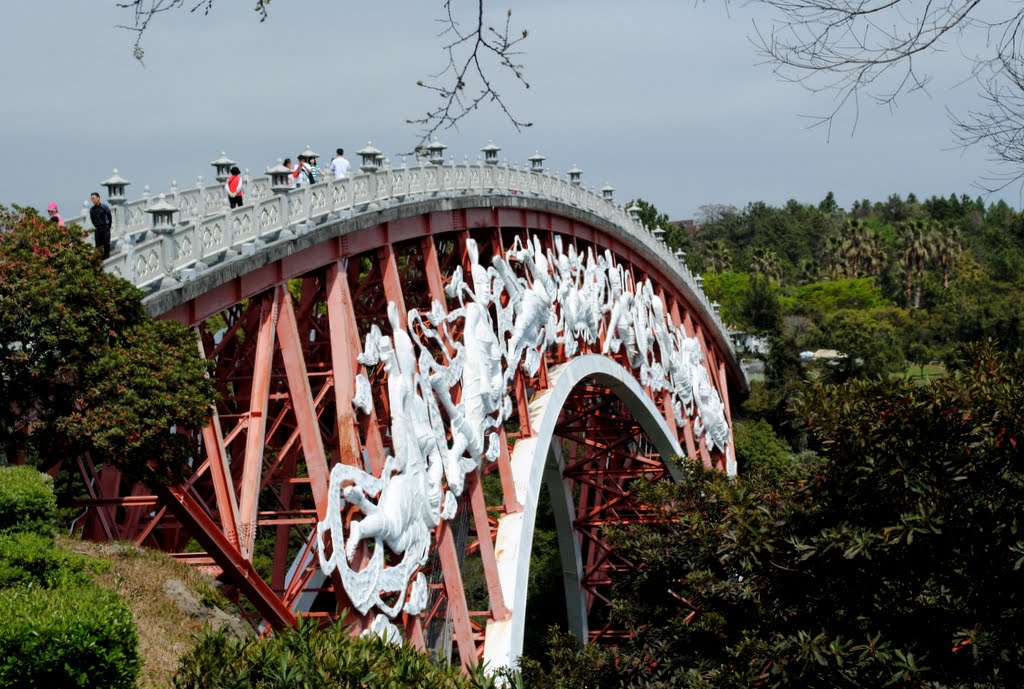
Some of the man-made structures were also unique and picturesque.
Seonimgyo Bridge
The omnipresent "dol hareubang" statues are protective spirits, carved from volcanic rock.
We saw lots of other cute statues in Hallim Park; not sure if they also have a special meaning.
Generally I felt like the food was more home-style and "authentic". We did eat at hotels once or twice, but generally we would drive around until we saw a sign that caught our eye. One time we ended up at a place in the middle of the island that served only one dish: spicy pork bulgolgi, cafeteria-style. Luckily it was not too spicy for D, there were unlimited sides, soup, and rice, and the total bill came out to roughly $8 USD.
This pork bone and potato soup may be the most delicious thing we ate in Korea. It was also huge; when we ordered it and another dish, the guy taking our order hesitated a bit, but as he spoke no English and we spoke no Korean, I guess he decided it would be too hard to try and change our minds.
There were little "museums" and studios all over the island. One of the most famous is the Teddy Bear Museum. I was skeptical at first but in the end I was really glad to have gone; there were teddy bear replicas of famous paintings (Mona Lisa, Sistine Chapel, The Thinker, The Kiss), famous people and moments in history (Charles & Di on their wedding day, the invasion of Normandy), and lots of other cute displays.
My favorite exhibit at the Teddy Bear Museum was this "seven continents" display.
Nearby was the Joanne Studio, where we saw lots of gorgeously handmade teddy bears.
We also stopped by the O'sulloc Tea Museum, known for its award-winning green teas (their green tea ice cream was delicious).
Of course, the hotels also had lots of activities going, too. We happened to coincide with the PGA's Ballantine's Championship (there were golf courses all over the island) and often saw people checking the players board in the hotel lobby. Before arriving, we'd chosen to stay at the Shilla rather than the Lotte Hotel based on price, but we eventually decided that the Shilla was more our style; the Lotte had lots of "family-friendly" attractions such as cute windmills and a volcano show, but the Shilla felt more laid-back and Zen.
We did go to the Lotte one night to check out the volcano, though I thought it was no more impressive than the Mirage's volcano in Las Vegas.
On the last day, we discovered the Shilla had an entire PS3 game room, complete with a library of games. Unfortunately, we only had time to stop by and take a quick glance.
We found Jeju Island quite pretty, and relaxing but not boring. I was glad that we'd rented a car; there were many tour buses and we were able to avoid the crowds by timing our stops (best times: early morning and during lunch).
On our second full day, after stopping by the teddy bear museums, we decided to drive out to Sunrise Peak despite the fog and rain, and we were rewarded by a short break in the clouds.
Then, on our very last day, we finally spent some time exploring the Shilla Hotel grounds.
Many Korean dramas are shot on Jeju Island, and there are little signs indicating exact filming locations. We ran across this one while wandering around the Shilla.
Before our trip we'd been debating between visiting Jeju Island, Gyeongju (a historic city), and Seoraksan (a national park). Based on advice from two native Koreans, we picked Jeju despite its touristy reputation, and I'm glad we did.
Tuesday, April 27, 2010
how much are *your* principles worth?
Yani Tseng won the Kraft Nabisco Championship (one of four LGPA majors) last month. That win, combined with Lorena Ochoa's retirement, has made her the second-ranked woman golfer in the world. She was recently offered a $25 million sponsorship by a Chinese group, and was widely expected to accept it.
My dad was saying yesterday that according to her father, she has rejected the offer. One of the conditions of sponsorship was that she would have to play under the Chinese (PRC) flag, rather than the Taiwanese (ROC) one. Apparently that was a deal-breaker.
I have much respect. That's a lot of money to turn down.
Wednesday, April 21, 2010
not following instructions
My HMO periodically sends out health newsletters. One of the common themes is "how to take care of your bones". I've heard the recommendations many times: take calcium with vitamin D, walk, run, and lift weights. Ironically, although one would think the calcium recommendation would be the easiest one to follow, it's the only one that I find difficult. I have three or four bottles of assorted vitamins in my desk at work, and they're all over four years old. (I wonder if vitamins go bad?)
Labels:
lifestyle,
medicine
Posted by
Emily
at
5:09 PM
0
comments
Sunday, April 18, 2010
onigiri roulette
D and I are in Asia again...we're in Korea this week, and then we'll be in Taiwan the following week.
After arriving in Seoul today, we were hungry and thirsty, so after checking in we hit up a 7-11. They had what looked like onigiri, but all the labels were entirely in Korean. We bought two random different ones anyway, and they both turned out to have kimchi in them (one had lots more than the other). I was stoked, D was less so. Yum.
Tuesday, April 13, 2010
break time
I'm in my third straight week of being onduty at work.
I spent the first week with a horrible cold, but figured it was kind of a plus being sick when I had to work late every day anyway.
The second week was supposed to be the last week, but then the schedule got shuffled, and I wound up taking on an extra week to cover a gap. Work work work, and then work some more.
Compare and contrast: My parents are on vacation in France with a bunch of their friends. This morning, my dad was telling me about their lunch at a Michelin 3-star restaurant, and how he was excited to meet the mayor of Tours.
Sigh. Vacation countdown: T-minus 5 days. Asia, here I come.
Labels:
lifestyle,
travel,
work
Posted by
Emily
at
10:04 AM
0
comments
Friday, April 02, 2010
American paranoia
There are so many things that we are paranoid about in this country, that people in other countries seem not to worry about.
The list of foods that pregnant American women "can't eat" grows longer every year: alcohol, sushi, raw meat, processed meat, pate, most seafood, soft cheeses, unpasteurized milk/juice, caffeine. I even saw a pregnant woman the other day avoiding beans. I have no idea what could possibly be wrong with eating beans. In Europe, pregnant women drink wine. In Japan, pregnant women eat raw fish. Neither seems to be a problem.
We refuse to let children eat peanuts and shellfish at a young age, in case they happen to be allergic to them. Yet, I wouldn't be surprised if we had the highest incidence of food allergies in the world.
We use anti-bacterial soaps and lotions for everything, on an everyday basis. I'm not a doctor, but I'm pretty sure the more that we use anti-bacterial products, the stronger the remaining bacteria become. I'll bet the US has more drug resistant bacteria than any other country, by now.
I can't think of any other examples off the top of my head, but I'm pretty sure there are more...
Labels:
lifestyle,
medicine,
rants
Posted by
Emily
at
10:12 PM
0
comments